Operation Epic Fury, the Strait of Hormuz crisis, and the widening conflict reshaping the Middle East. What it is, how we got here, and what questions it raises for students of American interventionism.
Seventy-three years of compounding grievances, missed diplomatic windows, and periodic violence that made the current war structurally predictable even if its timing was not.
To understand the 2026 war requires understanding the relationship that produced it. This is not a conflict born of a single provocation. It is the culmination of a strategic antagonism stretching back to the Eisenhower administration — an antagonism in which each side's grievances are real, even when their policy responses have been reckless. Said differently: both Washington and Tehran have been telling themselves a story about the other for seven decades, and both stories contain enough truth to sustain the hostility indefinitely.
The CIA and British MI6 orchestrate a coup overthrowing Prime Minister Mohammad Mossadegh, who had nationalized Iran's oil industry. The Shah is restored to power. For Iranians across the political spectrum, this remains the foundational act of American interference — the event that frames every subsequent U.S. action as imperial overreach. For Washington, the coup was Cold War pragmatism. For Tehran, it was the original sin.
Ayatollah Ruhollah Khomeini's revolution topples the Shah. In November, students seize the U.S. Embassy and hold 52 Americans for 444 days. Diplomatic relations are severed and never restored. The crisis creates an American wound — institutional, emotional, political — that persists in foreign policy circles decades later and undergirds the bipartisan consensus that Iran cannot be trusted.
The U.S. provides intelligence and material support to Saddam Hussein's Iraq during its eight-year war with Iran. Iran mines the Persian Gulf. The USS Samuel B. Roberts is damaged by an Iranian mine in 1988, prompting Operation Praying Mantis — in which the U.S. sinks multiple Iranian naval vessels. The USS Vincennes shoots down Iran Air Flight 655, killing all 290 civilians aboard. Washington calls it a tragic accident; Tehran calls it a war crime. Both responses reveal how the same event produces irreconcilable narratives.
Iran's covert enrichment program is exposed in 2002. Years of sanctions, UN resolutions, and Stuxnet-era cyber sabotage follow. The Obama administration negotiates the 2015 Joint Comprehensive Plan of Action, trading sanctions relief for nuclear restrictions — enrichment capped at 3.67%, centrifuge numbers sharply reduced. The deal's critics call it appeasement; its defenders call it the most rigorous nonproliferation agreement in history. Both camps are partially right, which is precisely what makes the nuclear question so resistant to resolution.
Trump unilaterally exits the JCPOA and reimplements a “maximum pressure” sanctions campaign. Iran responds by steadily increasing enrichment to 60% purity — far beyond civilian use, approaching weapons-grade. In January 2020, a U.S. drone strike kills IRGC Quds Force Commander Qasem Soleimani in Baghdad. Iran retaliates with ballistic missiles on Al Asad Airbase, causing traumatic brain injuries to over 100 U.S. troops. The strike eliminates Iran's most capable operational commander but hardens Iranian resolve and accelerates the very weapons programs it was meant to deter.
Israel launches Operation Rising Lion against Iranian nuclear and military targets, including B-2 strikes on hardened facilities at Fordow and Natanz. Iran retaliates with massive missile barrages against Israel. A ceasefire holds but diplomacy fails. In the aftermath, Iran accelerates enrichment. Weapons begin flowing to Kurdish regions in western Iran. The ceasefire does not end the conflict; it pauses it. And as any student of international law will recognize, a ceasefire does not terminate a state of armed conflict — a legal distinction that matters enormously in February 2026.
U.S. and Israeli forces launch nearly 900 strikes in the first 12 hours. Supreme Leader Ali Khamenei is killed in the opening wave. The largest American military operation in the Middle East since the 2003 invasion of Iraq has begun.
The network that made Iran a regional power without ever fighting a conventional war — and the question of whether it still exists.
Iran sits at the center of what scholars and policymakers call the “Axis of Resistance” — a network of allied state and non-state actors built over four decades as Tehran's primary tool for projecting power without committing its conventional forces. The logic is deterrence through distributed threat: if any state attacks Iran, it faces simultaneous retaliation from Hezbollah in Lebanon, Hamas and Islamic Jihad in Palestine, the Houthi movement in Yemen, and various Shia militia groups in Iraq and Syria. The word “axis” can mislead; this is less a formal alliance than a set of patron-client relationships bound together by shared hostility toward Israel and American presence in the region, mediated through the IRGC's Quds Force.
But here is the question students should be asking in March 2026: does the Axis still function? By the time Operation Epic Fury launched, the network was already severely degraded. Israel's campaigns in Gaza and Lebanon through 2023–2025 dismantled much of Hamas's military infrastructure and killed Hezbollah's senior leadership, including Secretary-General Hassan Nasrallah. The fall of the Assad regime in late 2024 removed Iran's most important state ally and severed the land corridor connecting Tehran to Beirut. The Quds Force headquarters was struck by the IDF on March 9. What remains is less a coherent network than a set of loosely connected actors, some of which — Hezbollah, notably — are still demonstrating significant capability (29 claimed attacks in a single 24-hour period on March 9–10, the highest since the war began, per CTP-ISW), while others are operating through front groups to avoid attribution.
Iran's rivalry with Saudi Arabia has defined Gulf politics for decades. A 2023 Chinese-brokered détente paused some of the proxy warfare, but the 2026 conflict shattered it: Iranian retaliatory strikes have hit Saudi territory, including the U.S. Embassy in Riyadh and Aramco's Ras Tanura and Berri facilities. Crown Prince Mohammed bin Salman, with U.S. backing, has declared Saudi willingness to use military force against further Iranian incursions. CTP-ISW assessed on March 2 that Iran is deliberately targeting Gulf energy infrastructure to compel the U.S. and its partners to pursue a ceasefire before achieving their objective of regime collapse.
Israel's role is co-belligerent but strategically distinct. Israeli intelligence drove much of the pre-war targeting, including the decapitation strike on Khamenei. Operation Roaring Lion runs in parallel with Epic Fury, with Israeli objectives centered on permanently eliminating Iran's nuclear breakout capacity. The IDF has struck over 300 ballistic missile launchers, targeted 11 of Iran's 17 tactical airbases, and destroyed F-14 fighter jets at bases in Esfahan. The operational coordination is tight; the strategic objectives are not identical. That divergence matters, and it is explored in the Discourses section.
The largest U.S. military operation in the Middle East since the 2003 invasion of Iraq, by the numbers and by the day.
On February 28, 2026, the United States launched Operation Epic Fury — a joint air and naval campaign with Israel (Operation Roaring Lion) — targeting Iran's military infrastructure, leadership, nuclear program, and naval capabilities. The force commitment is staggering: more than 50,000 U.S. troops, over 250 fighter jets, two carrier strike groups (USS Gerald R. Ford with Carrier Air Wing 8 and USS Abraham Lincoln with Carrier Air Wing 9), long-range bomber assets including B-2 Spirits, B-1 Lancers, and B-52 Stratofortresses, and autonomous drone platforms from the newly formed Task Force Scorpion Strike.
The initial wave comprised nearly 900 strikes in the first 12 hours. The campaign began with Tomahawk cruise missiles and air-launched standoff weapons — what CENTCOM later described as “multiple waves of cruise missiles obliterating Iranian command and control and air defense capabilities.” Israeli strikes focused on leadership targets in Tehran, including the compound where Khamenei was meeting with senior advisors. Intelligence for the timing came from Israeli PM Netanyahu, who informed Trump on February 23 of Khamenei's upcoming meeting location. By the end of Day 1, Khamenei was confirmed dead along with the IRGC chief of staff, the heads of intelligence and SPND (nuclear weapons research), and dozens of other senior officials. CBS reported that 40 officials were killed in the opening strikes.
Over the following days, the campaign expanded beyond air defense suppression and leadership targeting to IRGC headquarters, ballistic missile production facilities, naval bases along the entire Persian Gulf coast, nuclear-related infrastructure, and — critically — internal security institutions. The combined force has struck Law Enforcement Command headquarters, Basij bases, Cyber Police (FATA) stations, and IRGC rapid response units, particularly in Kurdish-majority western Iran. CSIS estimated the first 100 hours cost approximately $3.7 billion, with $3.5 billion unbudgeted. By Day 5, more than 2,000 targets had been struck. By Day 10, Hegseth described it as the “most intense” day yet.
General Caine reported on March 4 a “point of munitions transition” — the shift from expensive standoff weapons fired from outside Iran's engagement range to cheaper precision munitions delivered overhead. This transition is analytically important: it signals that U.S. forces have achieved sufficient air superiority to operate directly over Iranian airspace with manageable risk. CTP-ISW confirmed that the combined force advanced to a new phase targeting Iran's defense industrial base, especially missile production facilities.
Iran responded with missile and drone salvos targeting Israel, U.S. bases across the Gulf, and the territory of neighboring states. The scale of retaliation is significant even in degraded form. The Pentagon reported on March 5 that Iran had launched over 500 ballistic missiles and 2,000 drones since February 28 — more ballistic missiles than during the entire Twelve-Day War. Iran's drone production tempo is on pace for 4,000–5,000 Shahed-type munitions per month, matching Russia's sustained rate against Ukraine (per Hudson's Kasapoğlu).
In Kuwait, an Iranian drone struck a facility housing U.S. troops on March 2, killing six American service members. The U.S. Embassy in Kuwait was struck and closed indefinitely. The U.S. Navy's Fifth Fleet headquarters in Bahrain sustained damage. Dubai International Airport was hit, temporarily halting flights. Iranian drones struck the U.S. Embassy in Riyadh. Qatar declared force majeure on LNG exports after drone attacks. An Iranian drone hit a residential building in Manama, Bahrain on March 9, killing one and injuring eight. The UAE has faced the most Iranian attacks of any Gulf state since the war began — 121 drones and 16 ballistic missiles in a single 24-hour period on March 6–7 alone.
Mojtaba Khamenei, son of the killed Supreme Leader, was elected by the Assembly of Experts to succeed his father. The IRGC, Ali Larijani, President Pezeshkian, and Iran's senior political leadership pledged allegiance. This dynastic succession was unprecedented in the Islamic Republic's constitutional history and raises fundamental questions about legitimacy and institutional continuity under wartime conditions.
On February 28, a U.S. Tomahawk missile struck a girls' school adjacent to a naval base in Minab, near Bandar Abbas, killing approximately 170 students and wounding roughly 100. An internal U.S. military investigation subsequently determined American responsibility. Images showed fragments of American-made missiles at the site. The strike has intensified global criticism of the campaign and forced urgent questions about targeting processes, collateral damage thresholds, and the role of AI in target selection. The Iranian Red Crescent reported that as of March 10, 65 schools and 32 medical facilities have been targeted, with more than 10,000 civilian sites damaged since the war began.
CSIS's Mark F. Cancian and Chris H. Park produced the most rigorous public cost estimate of Epic Fury's opening phase. The numbers raise serious questions about sustainability.
Cancian and Park break the first 100 hours into three cost categories: operations and support (~$196M, mostly budgeted), munitions replacement (~$3.1B, entirely unbudgeted), and equipment losses and infrastructure repair (~$350M, unbudgeted). The daily burn rate: $891.4 million. The unbudgeted total — $3.5 billion — will require either a supplemental appropriation, reconciliation bill funding, or diversion from the DoD's existing $150 billion reconciliation allocation. Any of those mechanisms becomes, as Cancian notes, a political focal point for opposition to the war.
The munitions math is particularly instructive. The campaign consumed roughly 2,600 munitions in 100 hours, beginning with over 160 Tomahawks at $3.6M each in the opening wave. General Caine's announcement of a “munitions transition” on Day 4 marked the shift to cheaper stand-in weapons like JDAMs ($80,000 each) — a 45x cost reduction per unit. But air defense interceptors tell the opposite story: defending against 500 Iranian ballistic missiles and 2,000 drones cost an estimated $1.7 billion in interceptors alone, with Patriot and SM-3 missiles running $4.6M–$8.2M per shot against threats that cost Iran a fraction of that. This is the structural asymmetry the munitions debate is really about: when the interceptor costs more than the weapon it destroys, attrition math favors the attacker.
CSIS Data Visualizations — Cancian & Park, March 5, 2026
$125.2M in first 100 hours. ~$30M/day ongoing. Includes 50 stealth + 110 non-stealth + 80 carrier-based fighters.
Largest naval surge since October 2023. Two carriers, 14 destroyers, 3 LCS. $64.5M at H+100.
$15.4M/day for fleet operations. $5.9M unbudgeted in first 100 hours.
Qatar, Bahrain, Kuwait, and UAE collectively report intercepting 500 missiles and 1,300 drones as of March 3 — carrying much of the air defense burden.
The analytical weight of Cancian's work is not really about Iran. It is about what happens after Iran. U.S. annual production of Tomahawks is 57 units; the opening wave consumed roughly three years' production in a single night. THAAD interceptor production is 96 per year. The U.S. and South Korea are already discussing redeploying Patriot batteries from the Korean peninsula. The question Cancian forces you to confront: can the U.S. sustain this campaign while remaining credibly postured against China in the Pacific? The answer is not self-evident, and the munitions industrial base was not designed for simultaneous major theater conflicts.
The conflict has drawn in far more states and actors than the original U.S.-Israel-Iran triad. This is a mapping of kinetically or materially implicated parties as of March 11.
| Actor | Role / Involvement | Status |
|---|---|---|
| United States | Lead belligerent. 50,000+ troops, 2 CSGs, 250+ aircraft. Operation Epic Fury. | Active Combatant |
| Israel | Co-belligerent. Operation Roaring Lion. Leadership strikes, nuclear sites, continued Lebanon ops. | Active Combatant |
| Iran | Defending state. 500+ ballistic missiles, 2,000+ drones launched. Mining Strait of Hormuz. Cyber ops. | Active Combatant |
| United Kingdom | Granted U.S. use of Akrotiri (Cyprus), Fairford (England), Diego Garcia. RAF conducting defensive patrols. HMS Dragon deployed. F-35Bs downing drones over Jordan. | Active Support |
| France | Frigate Languedoc to Cyprus. Anti-drone systems deployed. Offered to defend Gulf states. Macron visited Cyprus March 10. | Active Support |
| Greece, Italy, Netherlands, Spain, Ireland | Frigates, F-16s deployed to defend Cyprus. Ireland indicated willingness to join European coalition. | Active Support |
| Ukraine | Cooperating on drone defense, leveraging Shahed counter-experience. Zelensky pledged to help defend allies. | Active Support |
| Russia | Providing satellite imagery intelligence on U.S. force positions (confirmed by WaPo, CNN, NBC). Prior delivery of S-400 components, Su-35 jets, Rezonans-NE radar, Khayyam spy satellite. | Covert Support to Iran |
| China | U.S. intel suggests preparation of financial aid, spare parts, missile components. Continued purchasing Iranian oil (~12M barrels since war began). Evacuated 3,000+ citizens. Abstained from UN vote. | Material Support to Iran |
| Hezbollah | Launched drone that struck RAF Akrotiri. 29 claimed attacks in 24hrs (March 9–10, highest of conflict). Long-range missiles reaching central Israel. Coordinating timing with Iranian barrages. | Iranian Proxy — Active |
| Iraqi Shia Militias | Islamic Resistance in Iraq claiming 20–37 daily ops. Embassy in Baghdad targeted March 7. Front groups used to obscure attribution. Targeted by U.S. strikes. | Iranian Proxy — Active |
| Houthis (Yemen) | Condemned strikes. Historically targeted Red Sea shipping and Israel. Capable of resuming attacks on UAE/Saudi. Watching Strait of Hormuz situation. | Potential Escalation |
| Turkey | NATO ally refusing airspace use against Iran. Two Iranian missiles intercepted entering Turkish airspace. Opposes Kurdish involvement. Deployed F-16s to N. Cyprus. Allegations of covert aid to Iran against Kurds. | Complicated / Defensive |
| Gulf States (SA, UAE, Bahrain, Qatar, Kuwait) | Struck by Iranian retaliation on military and civilian targets. Host U.S. forces. Energy infrastructure damaged. Qatar force majeure on LNG. Kuwait embassy closed. | Involuntary Participants |
| Kurdish Factions (PDKI, PAK, PJAK, Komala) | United under CPFIK. Mossad/CIA coordination confirmed. Limited border activity. Full offensive denied by all parties. Awaiting “green light.” | Potential Belligerents |
The Carnegie Endowment's Alexander Gabuev and Temur Umarov frame the Russia-China position incisively: neither has come to Iran's aid “in a forceful, kinetic, and undeniable way.” But that framing, while structurally correct, understates what is happening beneath the surface. Reporting confirmed across the Washington Post (Robertson, Nakashima, and Strobel), CNN (Bertrand et al.), and NBC News establishes that Russia is providing Iran with satellite imagery intelligence identifying the positions of American warships, aircraft, and ground forces. Iranian FM Araghchi told NBC on March 6 that Iran was receiving “political and otherwise” support from Russia and China, declining to elaborate. The intelligence sharing represents an indirect form of combat support — one that mirrors, with uncomfortable precision, the U.S. provision of targeting intelligence to Ukraine over the past four years of war with Russia.
China's position is more cautious but materially consequential. U.S. intelligence suggests Beijing is preparing financial assistance, spare parts, and missile components for Iran (CNN, March 6). China has continued purchasing Iranian oil through the Strait even as commercial shipping halted — an estimated 12 million barrels since the war began, per Kpler data reported by CNBC. But Beijing has not offered overt military support. The Carnegie analysis explains why: China's foreign policy has never included military rescue of distressed partners; its investments in Saudi Arabia ($50 billion agreement), the UAE, and the broader BRI network dwarf its trade with Iran; and Trump is due to visit Beijing in April. For China, the calculation is survivability through the Trump presidency without a trade war, not solidarity with Tehran at the cost of that objective. As Gabuev and Umarov put it, even if the Iranian regime falls, its successor will have “no choice but to engage with China, which holds a monopoly on the delivery of high-tech goods.”
The SpecialEurasia analysis maps the military-technical architecture of the Russia-Iran relationship more precisely: the Khayyam spy satellite (Russian-built Kanopus-V, providing 1.2-meter imagery), Su-35 deliveries (48-unit, ~$6.5B order), S-400 components for layered air defense, and the Rezonans-NE over-the-horizon radar. These are not improvised wartime transfers; they reflect years of strategic investment. For that reason, Defense Secretary Hegseth's claim that Russia and China are “not really a factor” is analytically unsupportable, even if it is politically convenient.
Turkey occupies what may be the most difficult strategic position of any state in the conflict. It is a NATO ally hosting U.S. bases — yet refused to allow its airspace to be used against Iran. Two Iranian ballistic missiles have entered or targeted Turkish airspace: one intercepted by NATO systems with debris landing in Dörtyol, Hatay Province; a second near Gaziantep. NATO confirmed both interceptions. Turkey has deployed F-16s to Northern Cyprus but opposes any Western arming of Kurdish groups, given the PKK's four-decade insurgency inside Turkey. Allegations have surfaced that Ankara is covertly aiding Iran against the Kurdish offensive. Meanwhile, Greek-Turkish tensions over Cyprus have sharpened, with both countries deploying forces near the bilateral border and each protesting the other's military movements while remaining reluctant to cooperate as NATO partners. Turkey is, in the most literal sense, surrounded by a war it did not choose and cannot control.
The drone strike on RAF Akrotiri in Cyprus on March 1 — launched by Hezbollah from Lebanon, using Iranian-made Shahed-type technology — dragged Europe into the conflict's orbit. Cyprus is an EU member but not a NATO member, meaning Article 5 cannot be invoked; but EU Treaty Article 42.7 (mutual defense) entered discussion. Greece deployed two frigates and F-16s. France sent the frigate Languedoc and anti-drone systems. Italy, the Netherlands, and Spain sent warships. Ireland offered to join the coalition. Even non-NATO states like Austria and Switzerland are being woven into European air defense through the Sky Shield initiative. NATO Secretary General Rutte declared the alliance would “defend every inch of NATO territory” but the bar for Article 5 activation remains high, and the sovereign base areas on Cyprus occupy an ambiguous legal space under Article 6. The war has forced Europe to confront a question it has been deferring: what does collective defense mean when the threat emanates from the Middle East and NATO's southeastern flank is simultaneously exposed to Russia?
A military operation that is simultaneously reported, denied, confirmed, retracted, and awaiting a green light that may never come.
The Kurdish dimension of this war exists in a genuine superposition: it is simultaneously reported as underway and denied by every party involved. On March 4, multiple U.S. media outlets reported a Kurdish ground offensive had begun from Iraq into western Iran. Israeli and American officials confirmed the activity to the Jerusalem Post. Israeli i24NEWS reported PJAK fighters moving into positions around Marivan. Yet the same day, PJAK, PDKI, PAK, and Komala all denied an offensive was occurring. The IRGC called the reports “subversive.” The White House said Trump had not approved any arming plan. Barak Ravid, who initially cited a U.S. official confirming the offensive, later acknowledged “conflicting reports.” Then, on March 7–8, Trump stated he did not want Kurdish fighters entering the war because it was “complicated enough” and he did not want to see Kurds “get hurt or killed.”
What is confirmed: the CIA has been supporting Iranian Kurdish groups for months prior to the war (CNN, March 3). The agency operates an outpost in Iraqi Kurdistan near the Iranian border. Israel's Mossad originated the plan for a Kurdish ground component — Israeli officials reportedly promised Kurdish factions political support for an autonomous region in a future post-regime Iran (Axios). Weapons were smuggled into western Iran beginning during the Twelve-Day War (ITV News). The Coalition of Political Forces of Iranian Kurdistan (CPFIK) was formally established six days before the war began. U.S. and Israeli strikes have heavily targeted security infrastructure in Kurdish-majority western Iran — police stations, border posts, IRGC rapid response units, LEC headquarters — which CTP-ISW noted may have “paved the way for a Kurdish advance.”
The Atlantic Council's expert panel identified the core dilemma with precision: a Kurdish offensive would stretch Iranian defenses and increase pressure on the regime, but it would simultaneously alarm Turkey (which has fought Kurdish insurgency for four decades), destabilize Iraq (whose Kurdish regional government has said it does not want attacks launched from its territory), and risk replicating the pattern of American Kurdish abandonment that has occurred repeatedly — in 1975, 1991, 2019. As one senior Kurdistan Regional Government official told CNN: “One day Trump says we will overthrow the regime, the next day he says something different. The policy is not clear.”
For that reason, the Kurdish offensive is best understood not as a military fact but as a strategic signal — one that is being calibrated, walked back, leaked, denied, and recalibrated in real time by at least five distinct actors (CIA, Mossad, White House, Kurdish factions, Turkish intelligence) with overlapping but non-identical interests. Whether a full-scale ground operation materializes remains, as of March 11, genuinely uncertain.
Twenty percent of the world's oil. Twenty-one nautical miles wide. Effectively closed.
The Strait of Hormuz is not merely a geographic feature; it is the single most consequential energy chokepoint on earth. In 2025, approximately 20 million barrels of petroleum products per day transited the strait — about 20% of global consumption, over a quarter of all seaborne crude flows. Qatar's LNG exports, representing 20% of the world's liquefied natural gas, pass through the same waterway. When the IRGC closed the strait on March 2, it weaponized a vulnerability that energy analysts have warned about for decades.
On March 2, IRGC naval commander Alireza Tangsiri stated that any vessel must obtain Iranian approval or face attack. By that evening, no tankers were broadcasting AIS (Automatic Identification System) signals in the strait. Protection and indemnity insurance was pulled for March 5, making transit economically impossible. U.S. officials described the waterway as a “death valley.” More than a dozen commercial vessels have been attacked since, killing at least seven seafarers. The Naval News analysis characterized the mining as a weapon of “fire and forget” capable of denying access to vast ocean areas — a lesson reinforced by the Russo-Ukrainian War, where mines broke free from moorings and threatened civilian shipping throughout the Black Sea.
Iran has begun laying mines in the Strait of Hormuz (CNN, citing U.S. intelligence). Only a few dozen have been placed so far, but Iran retains 80–90% of its small boats and minelayers — contradicting Trump's claim that Tehran has “no navy.” Iran's mine stocks are estimated at 2,000–6,000 units, many produced by Iran, China, or Russia. CENTCOM destroyed 16 Iranian minelaying vessels on March 10. Critically, the U.S. Navy decommissioned its last four dedicated minesweepers in the region in September 2025, leaving a capability gap. Trump posted on Truth Social that mines must be removed “IMMEDIATELY” or Iran would face consequences “at a level never before seen.” CBS's LaPorta reported Iran is using smaller craft carrying 2–3 mines each. The strait's mining represents a new escalation: cheap, persistent, and extraordinarily difficult to reverse.
CSIS's Asia Maritime Transparency Initiative used AIS ship-tracking data to show the Strait's closure is total — even for China, Iran's most important economic partner.
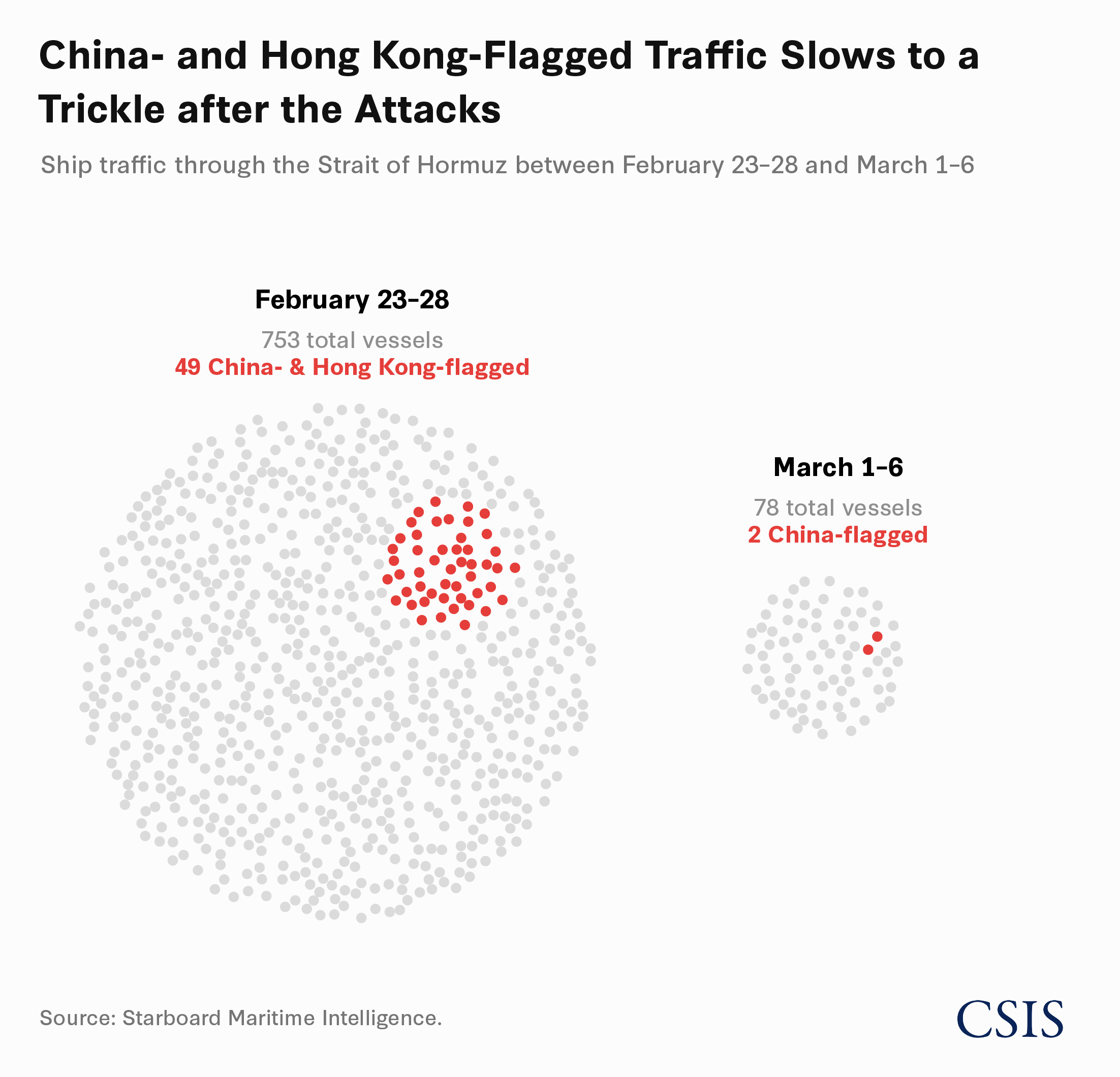
Prétat, Sato, Powers-Riggs, and Funaiole at CSIS produced the most granular open-source analysis of the Strait's closure using Starboard Maritime Intelligence AIS data. Their findings are stark: the strait averaged more than 153 vessel transits per day in the weeks before the war. By March 2, total traffic had collapsed to 13 transits — roughly 8% of normal volume, with only a single oil tanker observed. Since March 1, only 78 total vessels have been detected passing through, for a daily average of 13. Container ships and oil tankers, which together constituted 88% of pre-war traffic, have all but vanished.
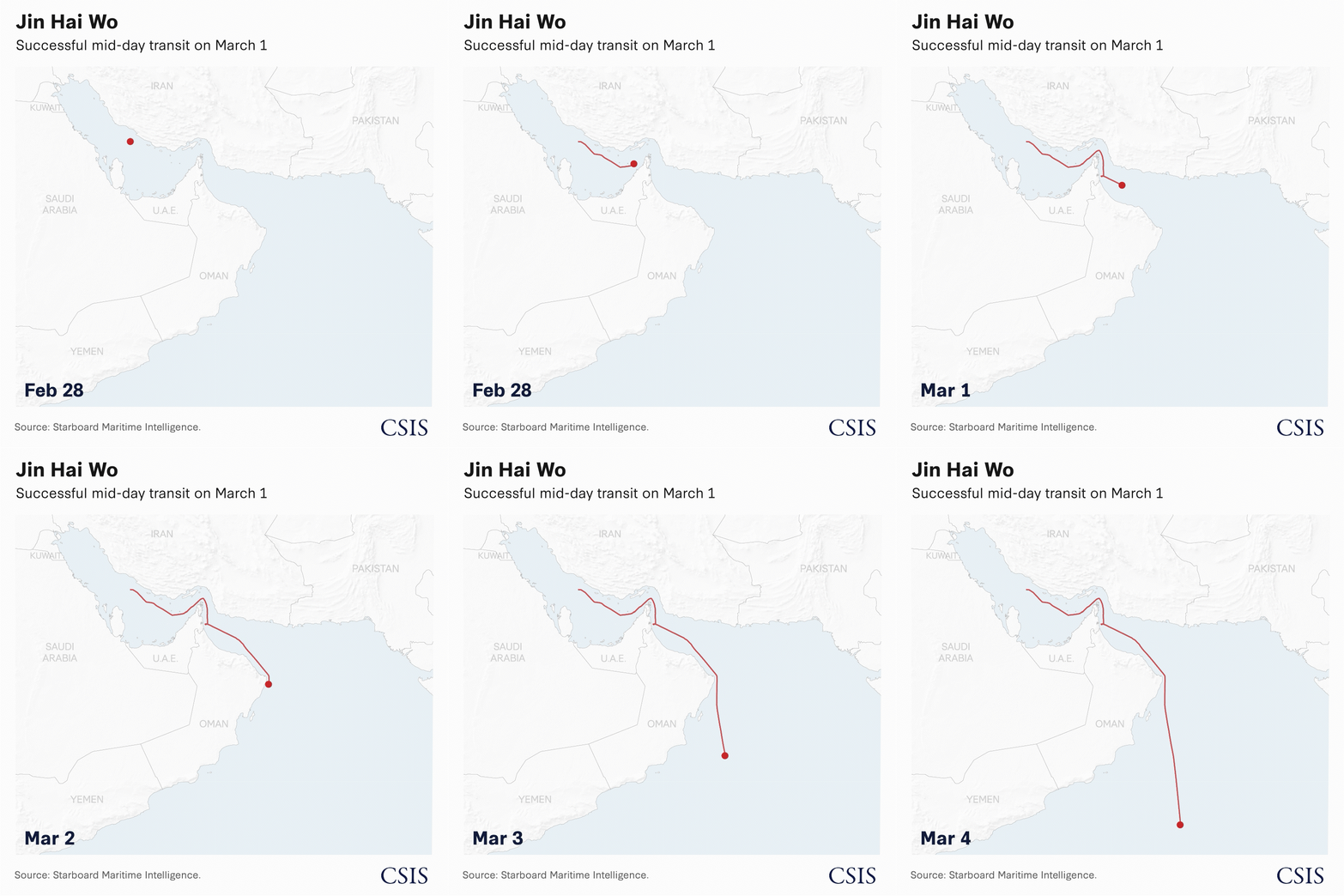
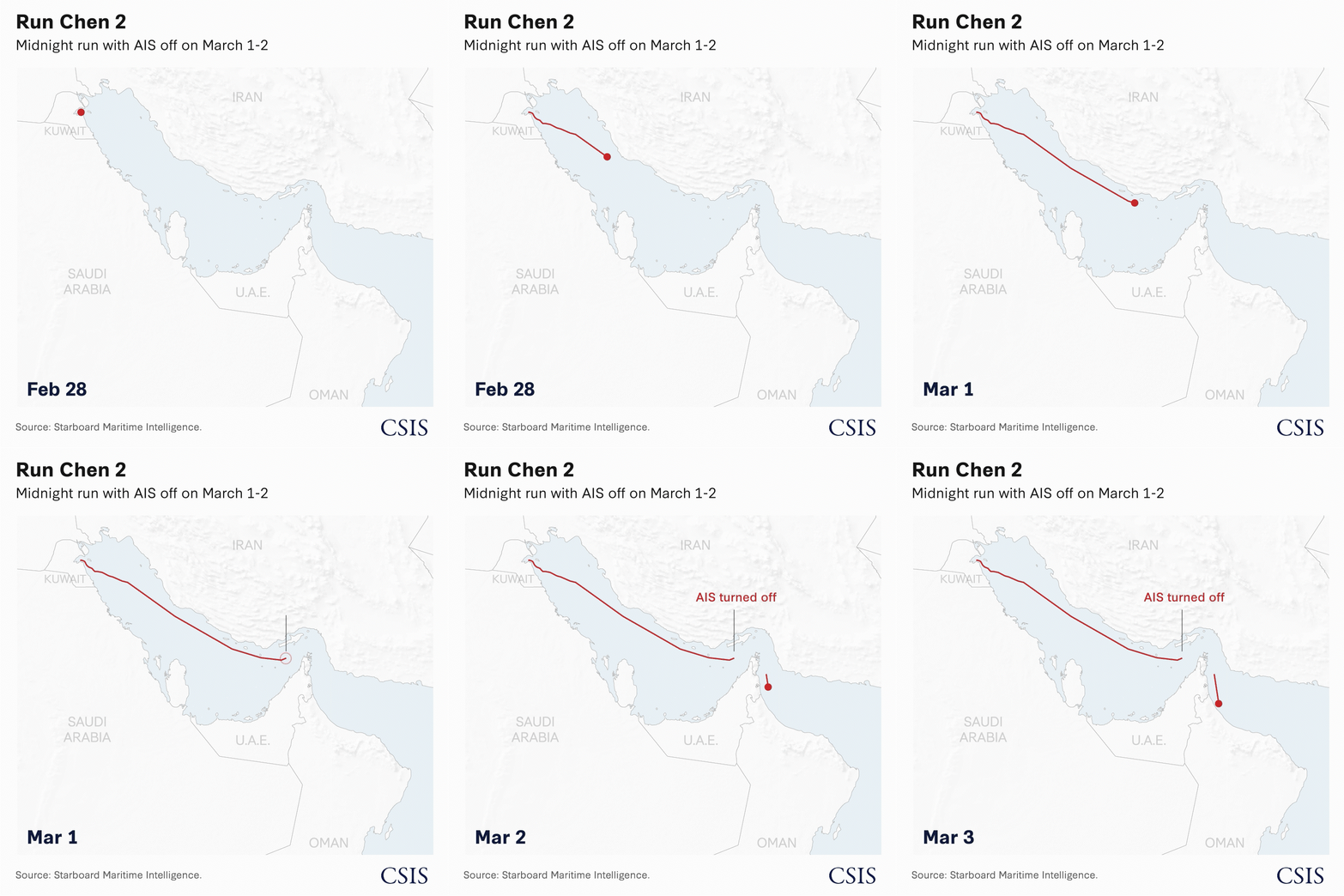
The China dimension is particularly revealing. Between February 23 and 28, more than 49 Chinese- and Hong Kong-flagged vessels transited the strait. Since March 1, only two Chinese-flagged ships have been observed making the passage. The bulk carrier Jin Hai Wo passed through midday on March 1. A container ship, Run Chen 2, appears to have made a midnight run with its AIS transponder turned off — its signal went dark at 9:30 PM local time near the western mouth, reappearing in the Gulf of Oman at 4:20 AM. This is the maritime equivalent of running a checkpoint with your headlights off.
Early reporting had suggested Chinese vessels might receive privileged passage, following the Houthi precedent of 2024, when Iran-backed rebels reportedly agreed to spare Chinese ships during their Red Sea campaign. But the data shows no such arrangement is functioning. 55 Chinese-flagged vessels remain trapped inside the Persian Gulf. In one telling incident, a Marshall Islands-flagged cargo ship named Iron Maiden changed its AIS destination to read “CHINA OWNER” before attempting transit on March 5 — invoking Chinese identity as a protective talisman. The gesture captures the desperation of the situation and the limits of Beijing's influence over Iran's wartime decision-making.
CSIS / Asia Maritime Transparency Initiative — AIS Ship-Tracking Visualizations
49+ Chinese/HK-flagged transits (Feb 23–28) collapsed to just 2 since March 1. 55 Chinese ships remain trapped in the Gulf.
Bulk carrier Jin Hai Wo — one of only two Chinese-flagged vessels to transit since March 1. Passed through midday.
Run Chen 2 went dark at 9:30 PM near the western mouth, reappearing in the Gulf of Oman at 4:20 AM. A “midnight run” with transponder off.
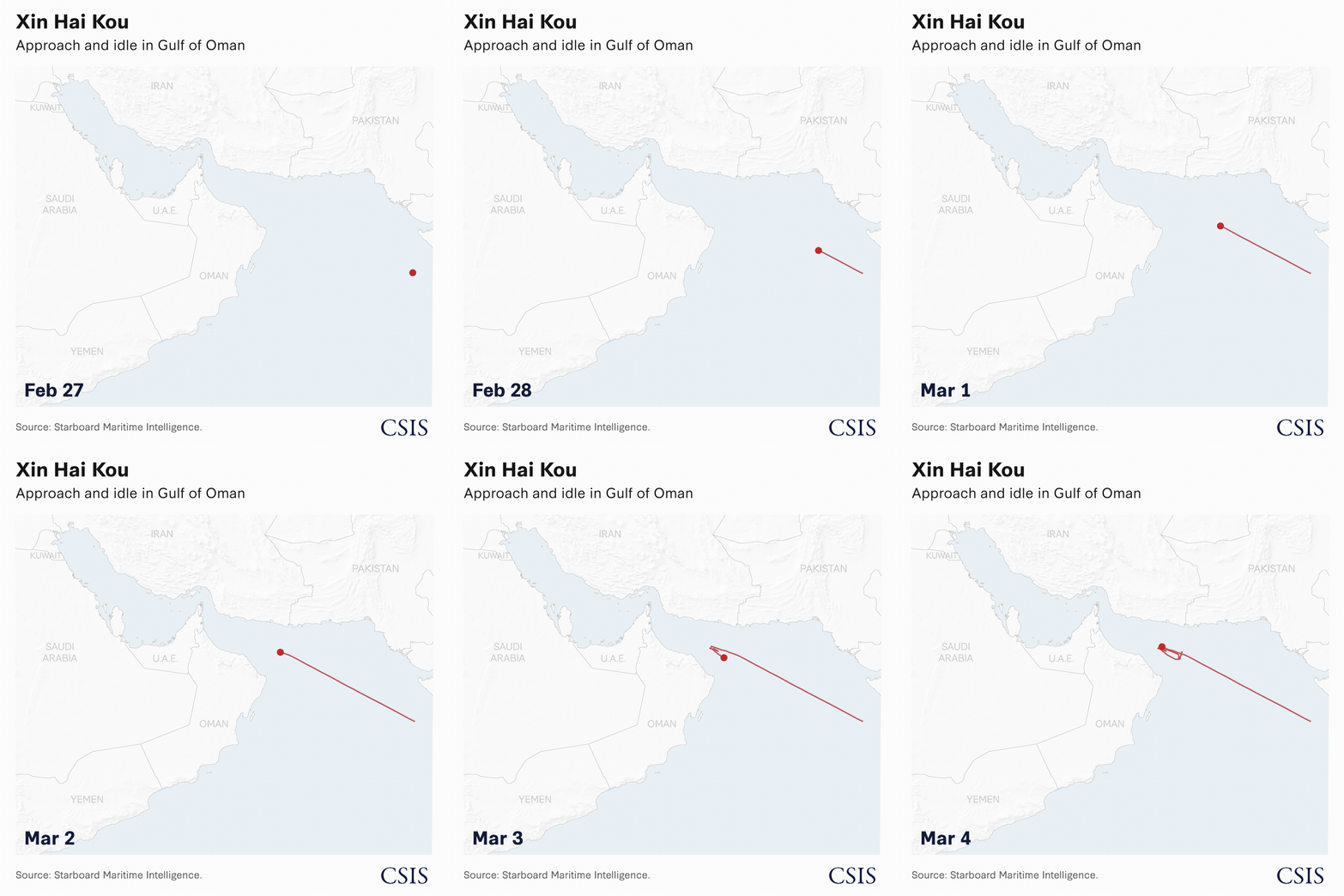
Cargo carrier Xin Hai Kou was heading toward the strait but is now idling in the Gulf of Oman. Dozens of Chinese vessels face the same calculus.
China imports 40% of its oil and 30% of its LNG through the Strait of Hormuz. Beijing has directed its oil refiners to halt fuel exports — a sign of growing unease. But the CSIS analysis reveals a deeper structural point: Iran's leverage over the strait cuts both ways. The closure hurts Iran's own remaining oil exports (estimated 12 million barrels shipped to China since the war began, per CNBC/Kpler) and undermines the very partner most likely to provide material support. Tehran is, in effect, using its most potent asymmetric weapon against the global economy while simultaneously degrading the economic lifeline connecting it to its last major customer. The question is whether this represents strategic desperation or a calculated bet that the economic pain imposed on the Gulf states and the broader world will force a ceasefire before Iran's own position becomes untenable. CTP-ISW assessed on March 2 that it is the latter.
The 2026 Iran war is the most consequential real-world stress test of AI-assisted targeting, autonomous drones, and bunker-penetrating weapons systems ever conducted.
The Low-cost Unmanned Combat Attack System — reverse-engineered from Iran's Shahed-136 at ~$35,000–$43,000/unit. Manufactured by Spektraworks (Phoenix, AZ) under a $30M contract. Deployed via Task Force Scorpion Strike. As Adm. Cooper put it: “We took them back to America, made them better, and fired them right back at Iran.” The strategic logic: mass-produced attrition drones that overwhelm air defenses through volume.
Lockheed Martin's Precision Strike Missile sees its first combat deployment. Compatible with HIMARS. Only 54 produced in FY2025. Represents a generational upgrade over ATACMS in range and accuracy.
CENTCOM confirmed AI tools are being used for intelligence synthesis and target selection. AI compresses the OODA loop (Observe-Orient-Decide-Act) from hours to minutes. The Pentagon's clash with Anthropic over ethical restrictions — and subsequent deal with OpenAI — has become a major parallel story. Rep. Sara Jacobs (D-CA): “AI tools aren't 100% reliable — they can fail in subtle ways and yet operators continue to over-trust them.”
USS Charlotte sank Iranian frigate IRIS Dena in the Indian Ocean with a Mk 48 torpedo — the first American submarine kill since WWII, the first such sinking since the Falklands (1982). The vessel was defenseless, returning from an international fleet review. Joint Chiefs Chairman Caine called it “an incredible demonstration of America's global reach.”
After years of cost overruns and skepticism, the F-35 is performing decisively in contested Iranian airspace: SEAD, precision strike, ISR. RAF F-35Bs have downed drones over Jordan. Sensor fusion and stealth capabilities proving essential for operations inside Iran's degraded but still active air defense network.
Patriot PAC-3 MSE ($4.6M/unit, 620 produced FY2025), THAAD ($12.8M/unit, 96 produced), SM-6 ($8.2M/unit). Annual production is limited. If the war extends weeks, interceptor depletion becomes a readiness concern for other theaters. U.S. and South Korea in active discussions about redeploying Patriot batteries from the Korean peninsula.
A state fighting with everything it has left — and the non-conventional tools it may not yet have deployed.
Iran entered this war with over 600,000 active-duty personnel, 2,000–3,000 ballistic and shorter-range missiles, and a drone capability centered on the Shahed series that has been combat-proven across three theaters (Yemen, Ukraine, now the Persian Gulf). Its navy was outclassed by the U.S. but designed for exactly this scenario: small-boat swarms, coastal missile batteries, submarines, and mine-laying capacity optimized for asymmetric denial in confined waters.
Despite rapid degradation — 80% of missile launchers destroyed per Israeli assessment, navy rendered “combat ineffective” per Hegseth, over 30 ships sunk — Iran has achieved outcomes that any honest assessment must acknowledge. It closed the Strait of Hormuz, removing 20% of global oil supply from circulation. It killed six American service members. It struck diplomatic facilities, energy infrastructure, and civilian targets across the Gulf. It forced Qatar to declare force majeure on LNG. It damaged Dubai International Airport. It mined the world's most critical energy chokepoint. And it maintained retaliatory capacity sufficient to keep the Gulf states anxious about the war's cost to them, which is precisely the strategic logic CTP-ISW identified: Iran is targeting regional infrastructure to compel a ceasefire before the U.S. achieves its objectives.
Palo Alto Networks' Unit 42 tracked approximately 60 hacktivist groups active by March 2, including the “Electronic Operations Room” formed on February 28. The most prominent persona, “Handala Hack” (linked to Iran's MOIS), has claimed operations against Israeli energy companies, Jordanian fuel systems, and Israeli healthcare. The FBI and NSA issued joint warnings that Iranian cyber actors may target U.S. defense contractors, critical infrastructure, and financial institutions. Iran's internet connectivity dropped to 1–4% on February 28, which Unit 42 assessed will hinder state-sponsored cyber operations in the near term — but hacktivist activity from outside Iran has surged, including pro-Russian groups joining the campaign.
The FBI's Los Angeles field office distributed a bulletin warning California law enforcement that Iran “allegedly aspired to conduct a surprise attack using unmanned aerial vehicles from an unidentified vessel off the coast” targeting California. The intelligence dates to early February, before the war. It is described as uncorroborated. Senior officials told CBS News there is “no credible intelligence” behind the warning, calling it informational rather than actionable. Nonetheless, CFR's Bruce Hoffman has warned that the U.S. “is in an unprecedented dangerous situation when the Iranian regime's desire to retaliate” could surface “now or at any time in the future,” citing Iran's established presence in Latin America, its cyberattack capabilities, and Hezbollah's global operational reach.
The questions that will shape how history judges this conflict. These are not sideshows; they are the analytical core.
CSIS's Mark Cancian and Chris Park produced the definitive public cost estimate: $3.7 billion in the first 100 hours, $891.4 million per day, with $3.5 billion entirely unbudgeted. The cost breaks into three categories: operations and support (~$196M), munitions replacement (~$3.1B), and equipment losses (~$350M). The only acknowledged equipment losses are three F-15s destroyed in a Kuwaiti friendly-fire incident ($103M each, three years to replace even with an open production line). But the munitions math is where the structural problem lives.
The campaign consumed ~2,600 munitions in 100 hours, beginning with 160+ Tomahawks ($3.6M each) and air-launched standoff missiles in the opening wave. General Caine's “munitions transition” on Day 4 marked the shift to JDAMs ($80,000 each) — a 45x cost reduction. But air defense tells the opposite story: defending against 500 Iranian ballistic missiles and 2,000 drones consumed an estimated $1.7 billion in interceptors. Patriot PAC-3 MSE rounds cost $4.6M each (620 produced/year). SM-3 interceptors cost $8.2M–$12M each. THAAD interceptors cost $12.8M each (96 produced/year). Only 57 Tomahawks were produced in FY2025. The U.S. Navy expended 200 SM-2 and SM-3 missiles against Houthi attacks over 15 months in 2024–25; Iran's opening salvos may have matched that expenditure in days.
Coalition allies absorbed significant burden — Qatar, Bahrain, Kuwait, and the UAE collectively report intercepting 500 missiles and 1,300 drones as of March 3 — but their inventories are not infinite either. The U.S. and South Korea are in active discussions about redeploying Patriot batteries from the Korean peninsula (Reuters). Said differently: the question is not whether the U.S. can sustain this campaign against Iran; the question is whether it can sustain it while remaining credibly postured against China in the Pacific. Cancian's work forces that question into the open. The munitions industrial base was designed for steady-state deterrence, not simultaneous major theater conflicts. Every interceptor fired over Bahrain is one that will not be available over Taiwan.
Though conducting parallel operations, the U.S. and Israel have meaningfully different war aims. Israel's Roaring Lion focuses on permanently eliminating Iran's nuclear breakout capacity and completing the degradation of the Axis of Resistance. The U.S. emphasizes destroying Iran's ballistic missile arsenal, rendering its navy ineffective, and — more ambiguously — facilitating regime change. Trump has spoken of “building a new country”; House Speaker Johnson has explicitly stated the U.S. should not nation-build. Israeli officials reportedly promised Kurdish factions political support for an autonomous region in a future Iran — a commitment the U.S. has not endorsed. Secretary of State Rubio told Congress in a closed briefing: “We're not arming the Kurds. But you never know with the Israelis.” The just-war tradition offers a relevant distinction here: jus ad bellum (right to go to war) may be shared between partners, but jus in bello (conduct in war) and jus post bellum (justice after war) require alignment on objectives, and that alignment is visibly strained.
The effective closure of the Strait of Hormuz has produced the largest disruption to global energy supply since 1973. Roughly 15 million bpd of crude and 4.5 million bpd of refined fuels are stranded in the Gulf. Gulf oil production dropped by an estimated 6.7 million bpd by March 10. Goldman Sachs has warned oil could reach $150/barrel. Global Witness and Rystad Energy estimate disruption at 10+ million barrels equivalent per day — 17 times larger than the 2022 Ukraine-related disruption. Asian markets have been hit hardest: South Korea's Kospi fell 6.2%, Japan's Nikkei dropped 5.2%. U.S. gasoline prices rose $0.43/gallon in one week. CSIS analyst Ben Cahill noted that the shift of ~20 million bpd off the market was unprecedented since the 1973 embargo. Russia benefits: higher oil prices fund its war machine, and Moscow is ramping exports to India and China. The Trump administration granted India a sanctions waiver to buy Russian oil. The energy crisis is simultaneously strengthening the case for renewable transition and for U.S. LNG export infrastructure — a tension that maps neatly onto existing partisan alignments.
This is the dimension of the war receiving the least attention and posing perhaps the most durable consequences. Burning oil depots near Tehran — the Shahran and Shahr-e facilities have been burning for days — are releasing benzene, sulphur dioxide, PM2.5, and carcinogenic compounds into the atmosphere. The UK-based Conflict and Environment Observatory has identified over 300 incidents with potential environmental impacts. Acid rain precursors are accumulating. Groundwater contamination from toxic runoff is projected across multiple provinces. But the most alarming dimension concerns water. Bahrain relies on desalination for 95% of potable water. Kuwait and the UAE are similarly dependent. Reports indicate damage to the Fujairah F1 desalination plant in the UAE and the Doha West plant in Kuwait. Iran itself entered the war with a water crisis already approaching “Day Zero” in Tehran. Kaveh Madani of the UN University has warned that damage to water infrastructure creates a “dangerous precedent.” Auroop Ganguly of Northeastern University states the risk plainly: “Oil built the Persian Gulf. Desalinated water keeps it alive. War threatens both.” One-third of the world's fertilizer trade also passes through the Strait, meaning the war's agricultural ripple effects may outlast its military ones.
Alphabetical by author last name. Selective, not exhaustive.
Assessment reflects original research efforts, analytical process, and personal insight; this guide has been critically elevated, organizationally collated, and visually polished using Claude Tools.